The AI Witch Hunt Is Costing Authors Real Money. Here's How to Protect Yourself.
Some AI accusations are true. Some are wrong, and they've cost writers book deals, prizes, and reputations anyway. A detector score won't save you. Your drafts will.
In May, the Authors Guild ran ten of its own articles through five AI detectors. Every article was published in 2022 or earlier, before anyone outside a lab was using generative AI. Some detectors got them all right. Others flagged the clearly human writing as machine-made (The Decoder).
The Guild’s conclusion about where that leaves writers was blunt. Relying on these tools, it said, “creates an environment reminiscent of witch hunts” (Authors Guild).
Six months later, the hunt is in full swing. I’ve watched it from both sides, both as an author and as an editor who asks every client about AI before we sign anything. Stacey and I have talked about it extensively on our Pros Talking Prose podcast. Here’s what it’s costing, why some of the accusations are fair, and what you can do this week to make sure you can prove your book is yours.
What a Wrong Accusation Costs
A $2.4 million book deal. This summer, a $2.4 million deal with Minotaur, a Macmillan imprint, for Jerry Falade’s debut crime novel fell apart after AI detectors reportedly found traces of machine drafting. His agent said she could no longer verify how the manuscript was developed and withdrew it. Film and TV interest went away, and Falade reportedly has to return the money. His response: “The accusations are wrong, and I am completely innocent” (Futurism). The detector in question has been proven to be inaccurate over and over, by the way, but even the hint of AI was enough to start the spiral.
Prizes and the work that follows them. Jamir Nazir won the Commonwealth Short Story Prize, and readers ran his story through Pangram, a popular detector. The Commonwealth Foundation reviewed his drafts, notes, and conversations with him, rather than trusting detector scores (which as stated above, we should never do), and concluded he hadn’t used AI. Granta, which published the story, ended its relationship with the prize anyway. In October, Simbarashe Kundizeza won the Caine Prize for African Writing for “The Blue Fighter,” Pangram flagged nearly all of it, and he answered on X: “I wrote ‘The Blue Fighter.’ I did not use generative AI to write it.” The judges said they would review his draft history (CNN, via WRTV).
Trust, and not evenly. Notice who keeps ending up in these stories. Cambridge professor Doyle D. Calhoun told CNN that unverified accusations spread fast online and land hardest on writers who aren’t white. Detectors key on surface patterns, and NPR’s reporting found that words like “delve,” frequent em dashes, and ideas grouped in threes can tip a result toward AI (NPR, via St. Louis Public Radio). Plenty of writers learned to write that way long before any chatbot did, not to mention the fact that AI was trained (arguably illegally in some cases) on human writing that used those very things. The Guild makes the same point: professional prose looks statistically like AI output because the models were trained on professional prose.
Even the good detectors aren’t perfect, if there even are any. Using AI to detect AI, aside from the watermarks now being implemented, almost guarantees false positives. Pangram’s makers put their false positive rate at about 1 in 10,000, but a 2025 University of Maryland study found it mislabeled 2 percent of documents (CNN). Even at that rate, across the volume of writing published every day, that error rate is huge, and it impacts real people and real lives. It can falsely ruin careers before they get started.
And Some Accusations Are Right
I’m not going to pretend every accused author is innocent. Some aren’t.
In 2025, readers of Lena McDonald’s Darkhollow Academy: Year 2 found an AI note sitting in the middle of chapter three: “I’ve rewritten the passage to align more with J. Bree’s style” (404 Media). Bree is a real, bestselling author. K.C. Crowne was caught the same way. In March, Hachette canceled the U.S. release of Mia Ballard’s horror novel Shy Girl after New York Times reporting raised AI questions; claims that up to 78 percent of it was machine-written forced agents and editors to ask whether they could spot this at all. As one information science professor told The Guardian, “We all work in an AI-hybrid world now” (The Guardian). Ballard denied the allegations (Wikipedia summary of coverage).
Nonfiction isn’t immune. Steven Rosenbaum acknowledged that his book The Future of Truth: How AI Reshapes Reality contained misattributed and false quotes that AI had invented (Wikipedia).
Those cases do real damage too. Every prompt left in a published novel makes readers more suspicious of the next author, and that suspicion lands on the people who did the work themselves. The cheaters and the witch hunters are feeding each other.
There’s also a cold business reason publishers care. As Futurism noted in the Falade case, a publisher may not be able to secure copyright on passages a machine wrote. If your contract says the work is original and yours, AI-drafted text is a breach waiting to happen.
The Reality of AI Voice
The truth is, Stacey and I, as professional editors, have seen and read enough AI that we can “hear” the AI ticks and voice just a few pages into a fiction work, and often in non-fiction too. It’s everywhere: in social media posts and emails, and even presentations and worksheets.
Most readers can spot the AI ticks as well, usually within the first chapter or two of your work, even after careful editing. A thorough re-write is often needed, or at least an extremely deep edit, providing you can somehow remove the watermarks most tools now include (and all will soon).
It’s past time to make decisions for yourself about the role you will allow AI to play in your work, both fiction and non-fiction, if you allows it to have a role at all.
How to Protect Yourself
The Commonwealth Foundation didn’t clear Nazir with a better detector, or in fact with any detector at all. It cleared him by reviewing his drafts and notes. That’s the lesson. The proof that you wrote your book is the process of writing it, and you have to keep that process visible, so you can prove it later.
Here are some real action steps you can (and probably should) take.
1. Don’t Let AI Draft for You
This is the whole game. Use AI to brainstorm if you want, to research, or to catch a typo. The Guild’s Human Authored certification still allows that kind of help (IBTimes UK). The moment a machine writes your sentences, though, you’ve lost the ability to swear you didn’t, and you may have broken your contract. This includes using tools like ProWriting Aid and Grammarly to “rephrase” or “rewrite” a sentence for you. If it shows you something needs to be changed, change it yourself, typing or dictating.
Those are the quiet ways it creeps in. Turn the rewrite features off. In my own editing, proofing tools can flag things, but I make every change by hand. If you hire an editor, ask in writing whether they use generative AI in their process manuscripts, and be sure the answer is included in your contract. You don’t want your editor to be the reason your work gets flagged. The Guild released model contract clauses this spring after reports of publishing professionals uploading manuscripts into consumer AI tools (Authors Guild model clauses).
2. Keep a Paper Trail While You Write
You can’t build a draft history after someone accuses you. Build it as you go. Thriller author Andrea Bartz, one of the lead plaintiffs in the Anthropic case, keeps it simple: “I draft my thrillers in Google Docs, which automatically saves my revision history” (Bartz’s Substack). Other writers save each draft as its own dated file.
Keep the messy stuff as well. Outlines, notes, research files, the scene you cut, the chapter you rewrote three times. A finished manuscript can be faked. Two years of false starts and margin notes are much harder to create after the fact.
3. Email Your Drafts to Yourself
This is the oldest backup trick there is, and it’s become the best proof-of-authorship habit too. An email sitting on a third party’s server has a date stamp you didn’t set.
Hugh Howey built it right into NEO, his free writing app. Press Command+E and NEO emails you a PDF of your current work in progress. It also creates a SHA-256 fingerprint of the file, which shows the file hasn’t been altered since. Howey’s point is that a run of those emailed copies proves you have “a work you’ve been writing over time” (Hugh Howey, “Introducing NEO”). He also notes why the fingerprint matters: an AI agent could someday fake a tidy history of drafts with false dates. A trail of timestamped emails is much harder to forge.
NEO is my pick among the writing apps I’ve tested, partly for this reason (my NEO review on YouTube). If you write somewhere else, you can still do this by hand. Email yourself the manuscript at the end of every writing week. It takes thirty seconds, and could be all the proof you need when the torches and pitchforks end up pointed your way.
4. Know What You’ll Say If You’re Accused
Ask what tool flagged the work and what score it gave. Ask whether a person read the manuscript, and what they saw. Then hand over the evidence of your process: version history, dated emails, notes, outlines. Calm and specific beats furious and vague. If you’re an Authors Guild member, they offer legal help to members who’ve been falsely accused (Authors Guild).
5. Consider Certifying Your Work
The Guild’s Human Authored certification isn’t just a badge. Authors sign a license warranting the text is human-written, and Guild CEO Mary Rasenberger has said false claims can bring breach of contract, trademark, and consumer fraud liability (via Bartz’s Substack). It won’t stop a stranger with a detector from posting about you. It does put your claim in writing, with consequences attached for anyone who lies.
The key is to make sure you are not lying when you certify. Not only is it bad form, but it cheapens the process for anyone else using it. Think using AI to draft is okay for you? That’s your choice, but own it and be honest about it. Take whatever comes as a result of your choice. You’re free to make it, but being deceptive will only steepen the potential consequences.
Where Publishing Goes From Here
Provenance is becoming part of the submission. Falade’s agent had vetted his manuscript for AI and taken his word for it. After this year, I’d expect agents and editors to ask for more than your word: a draft history, maybe a signed warranty, maybe a certification. The Guild is already asking publishers to put their AI policies in writing and to say when and how they use detectors (Authors Guild transparency principles). Prizes are learning to ask for draft histories, as the Caine judges did.
I think that’s mostly good, with one condition. The process has to be the evidence, not the detector score. The Commonwealth Foundation got it right: read the drafts, talk to the writer, make a judgment. A percentage from a tool that can’t explain itself shouldn’t end a career.
For writers, the shift is simple. Writing your own book used to be enough. Now you also need to be able to show your work, like this is high school math class. Start this week. Turn on version history, set a Friday reminder to email yourself your manuscript, and keep your notes. If no one ever asks, you’ve lost nothing. If someone does, you’ll be glad you have them.
Sources
- The Decoder, “Authors Guild test finds some AI detectors perfectly identify human writing while others fail on every single text,” May 2026.
- Authors Guild, “Can AI Detectors Be Trusted? The Authors Guild Put Five of Them to the Test,” May 2026.
- Futurism, “Major Publisher Cans $2.4 Million Book Deal After Author Was Accused of Using AI,” July 31, 2026.
- T.M. Brown, CNN, “Authors fight back against AI accusations and faulty detection tools,” republished by WRTV, October 21, 2026.
- NPR, “Your writing was flagged as AI. What does that actually mean?,” via St. Louis Public Radio, October 31, 2026.
- 404 Media, “Authors Are Accidentally Leaving AI Prompts In Their Novels,” May 23, 2025.
- Amelia Hill, “‘Soon publishers won’t stand a chance’: literary world in struggle to detect AI-written books,” The Guardian, March 29, 2026.
- Wikipedia, “Shy Girl” and “The Future of Truth (Rosenbaum book).”
- IBTimes UK, “Authors Furious as Publishers Cancel Book Deals Over Unproven AI Claims,” 2026.
- Authors Guild, “Use of AI in Publishing and New Model Contract Clause,” April 16, 2026.
- Andrea Bartz, “So…how can you prove your work’s not AI-generated?,” March 30, 2026.
- Hugh Howey, “Introducing NEO,” August 10, 2026.
- Authors Guild, guidance for members falsely accused of AI use and AI transparency principles for publishers.
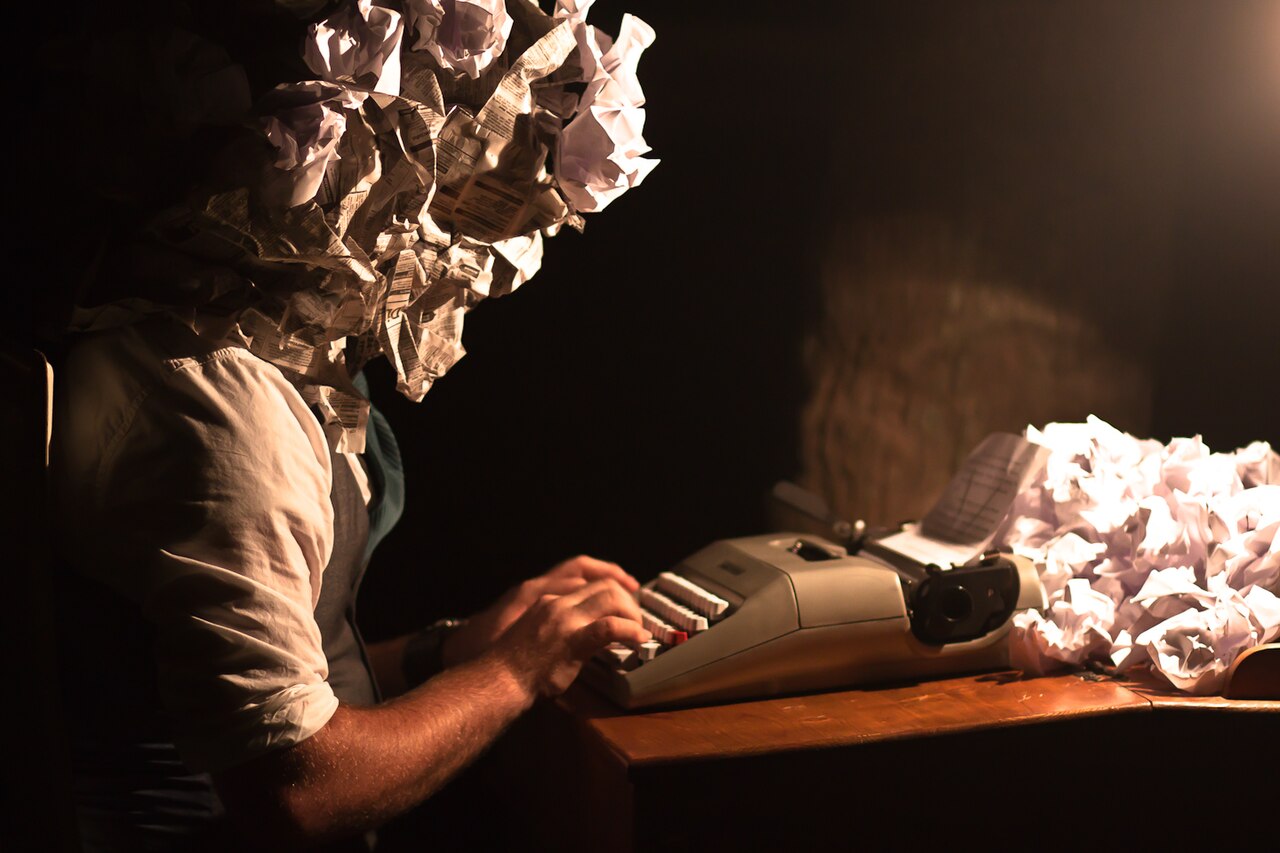
Featured image: “Writer’s Block I” by Drew Coffman, via Wikimedia Commons, licensed under CC BY 2.0.
